

A Filipino American Experience: Reflections on 9/11 at the Pentagon
By: Veronica Leighton
Every year for the last twenty-five years, the generation that had witnessed the 9/11 terrorists attack on New York’s Twin Towers still remembers and can’t forget that horrible day, that killed more than two thousand lives at the towers, the hijacked planes, and the Pentagon. On its 25th anniversary, we’ve read unforgettable stories from families and friends of the victims on television, print media, reels, ipods, and blogs, and personal statements from individuals; tear-jerking stories of the departed before and after it had happened.
We are proud to share a kababayan’s narrative about his heroic participation in the aftermath of the chaotic, dreadful, and surprised terrorists’ attack in New York’s Twin Towers on that fateful day of 9/11.
His name is Edward Brotonel, an outstanding and upstanding kababayan living in Chicago. Ed is the son of a World War II veteran from Batangas and came to Chicago in 1976 after graduating from San Beda College and the Philippine College of Criminology. He joined the U.S. Army in 1979 as a Military Policeman and joined the Army’s Criminal Investigation Division (CID) where he rose in positions from Special Agent to Battalion Operations Officer. Ed retired as a Chief Warrant Officer Four in 2003 with 24 years service. Ed lives in Chicago with his wife Anita and daughter.
“Forty-five years ago, I was assigned as the Assistant Operations Officer for the Washington Battalion, U.S. Army Criminal Investigation Division (CID), headquartered at Fort Myer, Virginia. Our Area of Responsibility at the time covers eleven Northeastern States.
On the early morning of September 11, 2001, I traveled with U.S. Army Chief Warrant Officer 5 Dave Adams, Operations Officer, from Washington, DC to Newark, New Jersey, as we were in route to the Fort Monmouth, New Jersey to conduct a Staff Assistance Visit (SAV) to our CID Office there. I could not have imagined how drastically the New York City skyline would change within just a few hours.
While conducting the Staff Assistance Visit at the Ft Monmouth CID Office, Dave and I received shocking news: a plane had struck the World Trade Center. Moments later, we learned the Pentagon had also been hit. Realizing the gravity of the situation, we knew we needed to return immediately to our office at Fort Myer, Virginia.
With all airports closed, our only option was to drive back. I joined Dave, Special Agent in Charge Tom Roberson, and Special Agent Wahl as we made our way to Washington, D.C., using the Fort Monmouth CID duty agent vehicle.
Expecting significant delays and heavy congestion, especially with New York City effectively shut down, I was surprised to find the roads nearly empty. It wasn’t until we reached Fort Myer Wright Gate that we encountered traffic, held up by thorough security checks by the MPs.
Arriving at the Pentagon that afternoon, I was met by the sight of smoke still billowing from the building and occasional flames leaping from the damaged roof. The courage and commitment of the firefighters working atop the Pentagon immediately struck me. All around, medical personnel, law enforcement officers, military personnel and additional firefighters stood ready, awaiting their turn to relieve those already engaged in the response.
The scene was chaotic, yet there was a clear sense of order; each agency present was following a coordinated plan. The FBI evidence team, together with CID agents from the Washington DC Office and CID Headquarters
at Fort Belvoir, VA, worked side by side to recover plane debris and other crucial evidence. The U.S. Army’s Old Guard, based at Fort Myer, and other law enforcement agencies were also assisting the FBI. At the Navy Annex, where witness interviews were being conducted, there were more law enforcement agents than witnesses needing to be interviewed. Another notable aspect was the presence of Red Cross Volunteers. They efficiently distributed water, sodas, and boxed meals to the personnel on site. Their preparedness and organization underscored that they, too, had contingency plans for such emergencies.
From the moment I arrived, the sheer physical devastation at the Pentagon was overwhelming.
Despite knowing lives had been lost, the true human cost did not fully register until around 7 p.m. when I encountered the wife of a command sergeant major. She anxiously searched for her husband, who worked at the Pentagon and had yet to return home or make contact. Watching her pace the scene, desperate for information, brought the reality of loss and grief into sharp focus—it was a sobering reminder that many families were enduring the same uncertainty and pain.
That evening, I was assigned to lead the night shift at our newly activated Emergency Operations Center. For the following two weeks, I managed requests to investigate suspected terrorist activities and oversaw the CID Task Force’s night shift, which assisted the FBI in searching through the Pentagon’s debris and rubble. During this period, a CID team recovered the black box from American Airlines Flight 77, the plane that the terrorists had crashed into the Pentagon.
A few months later, I was one of those interviewed by U.S. Army historians about my experiences on September 11. This oral history interview is now part of the historical record of 9/11. This can be accessed online by doing a Google search – my name, Edward Brotonel followed by 9/11 oral histories.”
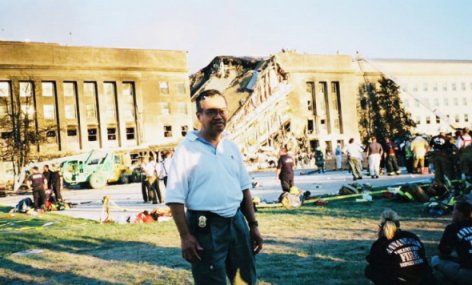
CW4 Brotonel at the Pentagon on 9/11 assisting in the recovery efforts, later designated as Operation Noble Eagle.
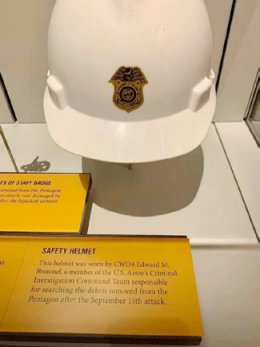
Image shows the hard hat worn by CW4 Brotonel during Operation Noble Eagle displayed at the U.S. Army National Museum, Fort Belvoir, Virginia.
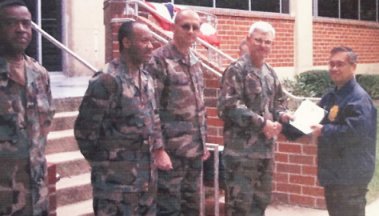
CW4 Brotonel receiving an award from Major General Donald Ryder, Commander, Army CID, for exemplary performance of duty during Operation Noble Eagle.