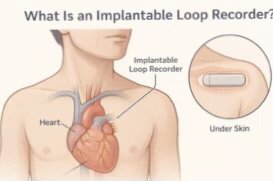


Implant Loop Recorder (ILR)
By: Lourdes G. Mon
Last month, after taking a shower, I suddenly felt weak and sat down on the rocking chair in our bedroom. A few moments later, I lost consciousness. I don’t remember fainting, but my sister heard a loud thud, alerted my husband, and they found me passed out on the floor.
Paramedics arrived quickly, and I regained consciousness as they were assessing me. Although I initially resisted going to the hospital, they insisted —and they were right. I needed medical attention.
To my surprise, my cardiologist wasn’t the only one evaluating me. Six medical students, under his supervision, took part in diagnosing my condition. They asked detailed questions, gathering every piece of information needed to understand what had happened and what care I required.
Several important observations emerged. First, I had taken a longer-than-usual shower, which can contribute to fainting. Second, I don’t drink enough water daily, and I was given about 64 ounces of fluid intravenously.
Third, I learned that I’m supposed to follow the 3-3-3 walking rule—three minutes brisk walking, three minutes slow walking, repeated five times for a 30-minute session. Although my husband and I walk regularly, usually about four blocks, I wasn’t following this structured method.
Because this wasn’t my first fainting episode—the earlier one happened during a Lions Club meeting—my cardiologist and his team concluded that I needed an implantable loop recorder to monitor my heart’s activity. I had never heard of such a device, and I suspect many people haven’t either. One doctor mentioned that I may have experienced small, unnoticed heart rhythm disturbances in the past.
An implantable loop recorder (ILR) is a small device that continuously records the heart’s electrical activity for up to three years. It sits under the skin of the chest and helps the healthcare team understand how the heart behaves during everyday activities. ILRs are commonly used to investigate unexplained fainting, palpitations, very fast or slow heartbeats, and hidden rhythms that may increase stroke risk, such as atrial fibrillation, which I have experienced.
The implantation is a minor procedure. The cardiologist places the device under the skin of the chest wall, where it functions like a long-term electrocardiogram (ECG). It automatically detects and records abnormal electrical signals, even when there are no symptoms. The device is small—less than half an inch thick and about 1 to 2 inches long. Inside its metal casing are an electrical circuit and a battery. It syncs with a handheld activator and stores data much like a USB drive, capturing graphs and numbers that show heart rate and rhythm. This information is transmitted to my cardiologist for review.
In conclusion, I am grateful that my trusted doctor made this decision for me. The implantable loop recorder is now my new companion—my “best friend”—and it will stay with me for quite some time, helping keep my heart health closely monitored.