


Bata Korner
By: Boom Boom Cabalona, Kenzo Pascual Wildoer, Christopher Miranda

A major move in Filipino education According to reports, the Philippines is now accepting American students for special courses offering academic credits and cultural immersion, announced April 2, 2026. Officials say programs include short-term and semester exchanges through partnerships with U.S. universities, expanding global education ties. (META)

Psychologists believe that children who sing often tend to be more intelligent. If your child is constantly singing, it might be a sign that they are developing strong cognitive skills. Singing helps with language development, memory, and emotional expression, all of which contribute to intellectual growth.
When children sing, they engage their brains in complex processes, which strengthens their memory and helps with learning new words. This constant practice also improves their ability to focus, solve problems, and communicate effectively. So, if your little one is always humming their favorite tune, you might just be raising a future genius.
Encourage their musical exploration, it’s more than just fun, it’s an important part of their development. (META)
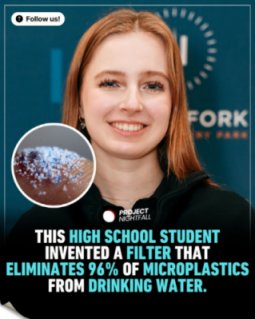
Mia Heller was 18 years old when she invented a water filtration system that removes 95.5% of microplastics from drinking water. She built it in her garage in Warrenton, Virginia.
The inspiration came from her own home. A few years ago, Heller learned that the local water in her area was contaminated with PFAS and microplastics. Her family installed a filtration system, but watching her mother constantly replace expensive filter membranes made her think there had to be a better way.
Her system uses ferrofluid, a magnetic liquid, to capture microplastic particles as water flows through a three part system. A magnetic field then pulls the contaminants out, and the ferrofluid gets recovered and reused in a closed loop. The device is about the size of a bag of flour and could fit under a kitchen sink.
She built her own turbidity sensor to test the results. Her tests showed the prototype removed 95.52% of microplastics and recycled 87.15% of the ferrofluid. Traditional water treatment plants typically remove between 70% and 90% of microplastics.
Heller is a student at Kettle Run High School and also takes math, science, and technology classes at Mountain Vista Governor’s School. She was a finalist at the 2025 Regeneron International Science and Engineering Fair, where she received a $500 award from the Patent and Trademark Office Society.
Microplastics are tiny particles measuring about 1 nanometer to 5 millimeters in size. They come from degraded plastic and have been detected in more than 1,300 species, including humans (META)